|
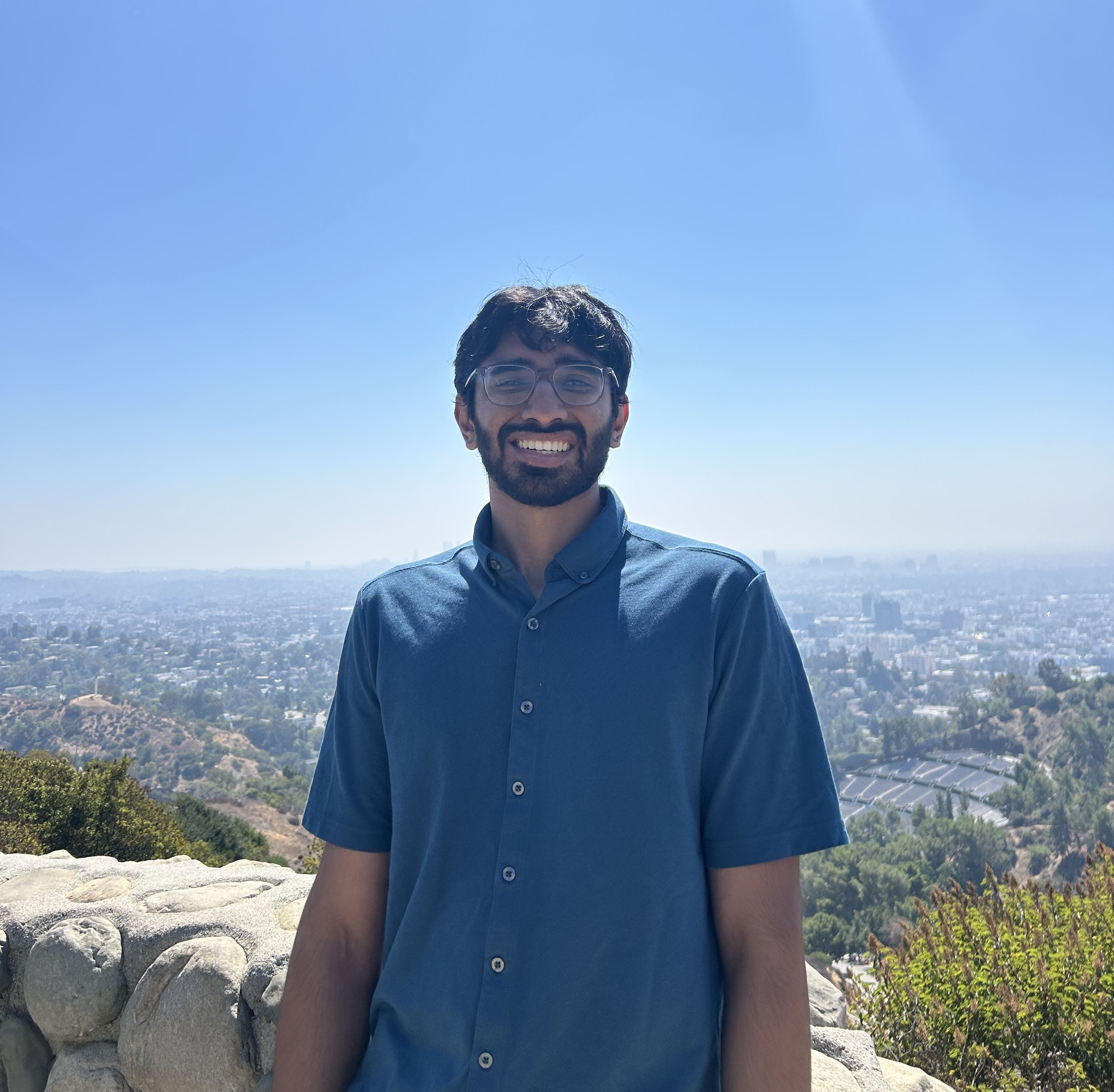
Vignesh ViswanathanI am a Computer Science PhD candidate at the University of Massachusetts Amherst, where I am advised by Yair Zick. Prior to joining UMass Amherst, I received my undergraduate degree at IIT Kharagpur. I like working on combinatorial problems in computational economics. My current focus is on problems in fair allocation and two sided matching. I have also worked on graph arrangements, market equilibria and explainable AI during my PhD. During my PhD, I have been fortunate to intern at Microsoft Research (Summer 2022) and Adobe Research (Summer 2024). I have also had the pleasure of visiting Rohit Vaish at IIT Delhi (Winter 2024) and Siddharth Barman at IISc Bangalore (Winter 2025). I am on the academic and industry job market and expect to graduate in Spring 2027. Please reach out if you think I would be a good fit! Email / CV / Google Scholar / Twitter / Github |
|
PublicationsUnless otherwise mentioned, authors are alphabetically ordered. For papers where authors are ordered by contribution, * is used to denote the lead author(s). |
|
[W4] Vignesh Viswanathan Working Paper, 2026 arXiv / tldrTitle says it all. The algorithm improves over the previous best appromation algorithm for the problem by a small constant factor. |
|
[W3] Siddharth Barman, Vignesh Viswanathan Working Paper, 2026 arXiv / tldrWe study a generalization of the Hajnal-Szemeredi theorem to vertex-weighted graphs. |
|
[W2] Vignesh Viswanathan Working Paper, 2026 arXiv / tldrWe use the probabilistic method to find a balanced graph partition that is both approximately envy-free and approximately in the core. |
|
[W1] Alon Eden, Vignesh Viswanathan, Yair Zick Working Paper, 2026 arXiv / tldrThe paper studies two sided matching where one side has matroid rank valuations and the other side has unit demand valuations. |
|
[C15] Telikepalli Kavitha, Surya Panchapakesan, Rohit Vaish, Vignesh Viswanathan, Jatin Yadav WINE, 2026 arXiv / tldrThe paper studies the best-of-both-worlds framework for fair allocation of indivisible goods, with a focus on stronger ex-post guarantees. |
|
[C14] Vignesh Viswanathan EC, 2026 arXiv / tldrA new dictator test for allocation problems with applications to Nash welfare, budgeted allocation and GAP. |
|
[J3] Vignesh Viswanathan, Yair Zick ACM Transactions on Economics and Computation, 2025 link / tldrA framework that implies efficient algorithms for almost all fairness objectives when agents have binary submodular valuations. Subsumes our AAMAS 2023 and EC 2023 papers. |
|
[C13] Zack Fitzsimmons, Vignesh Viswanathan, Yair Zick AAMAS, 2025 arXiv / tldrHardness results for fair allocation under ternary valuations. We also prove an important result about order neutral submodular valuations, generalizing a result from our WINE 2023 paper. |
|
[C12] Zhengmian Hu*, Tong Zheng, Vignesh Viswanathan, Ziyi Chen, Ryan A. Rossi, Yihan Wu, Dinesh Manocha, Heng Huang ICLR, 2025 arXiv / tldrImproved results on multi-draft speculative decoding. This paper contains a surprising connection between multi-draft speculative decoding and total unimodularity. |
|
[J2] Hadi Hosseini, Andrew McGregor, Justin Payan, Rik Sengupta, Rohit Vaish, Vignesh Viswanathan Autonomous Agents and Multi-Agent Systems (JAAMAS), 2024 link / tldrHow to assign a set of numbers to the vertices of a graph so as to minimize the sum of absolute differences along the edges? Subsumes our AAMAS 2023 paper. |
|
[J1] Jenny Hamer, Nicholas Perello, Jake Valladares, Vignesh Viswanathan, Yair Zick Transactions on Machine Learning Research, 2024 link / tldrA new method to generate counterfactual explanations for machine learning models. |
|
[C11] Hadi Hosseini, Andrew McGregor, Rik Sengupta, Rohit Vaish, Vignesh Viswanathan AAMAS, 2024 arXiv / tldrApproximation algorithms for the graphical house allocation problem studied in our AAMAS 2023 paper. Also, Ramanujan graphs and a cool connection between graph cuts and bitstrings. |
|
[C10] Gagan Biradar, Yacine Izza, Elita Lobo, Vignesh Viswanathan, Yair Zick AAAI, 2024 arXiv / tldrCooperative game theory meets formal logic meets model explanations! |
|
[O1] Arpita Biswas, Justin Payan, Rik Sengupta, Vignesh Viswanathan Book Chapter in Ethics in Artificial Intelligence: Bias, Fairness and Beyond (Springer), 2023 link / tldrThanks to Arpita, I got to be co-author of a book chapter! |
|
[C9] Cyrus Cousins, Vignesh Viswanathan, Yair Zick WINE, 2023 arXiv / tldrFair allocation of indivisible items when agents valuations are submodular and each item has a marginal contribution of -1, 0 or some positive integer c. |
|
[C8] Cyrus Cousins, Vignesh Viswanathan, Yair Zick WINE, 2023 arXiv / tldrAlgorithms for fair allocation of indivisible items when agents valuations are submodular and each item has a marginal contribution of 1 or some positive integer c. |
|
[C7] Vignesh Viswanathan, Yair Zick EC, 2023 arXiv / tldrA framework that implies efficient algorithms for almost all fairness objectives when agents have binary submodular valuations. Superseded by our TEAC 2025 paper. |
|
[C6] Vignesh Viswanathan, Yair Zick AAMAS, 2023 arXiv / tldrA fast algorithm to compute leximin allocations when agents have binary submodular valuations. Superseded by our TEAC 2025 paper. |
|
[C5] Hadi Hosseini, Justin Payan, Rik Sengupta, Rohit Vaish, Vignesh Viswanathan AAMAS, 2023 arXiv / tldrHow to assign a set of numbers to the vertices of a graph so as to minimize the sum of absolute differences along the edges? Superseded by our JAAMAS 2024 paper. |
|
[C4] Justin Payan, Rik Sengupta, Vignesh Viswanathan AAMAS, 2023 (Extended Abstract) arXiv / Code / tldrCan we compute allocations that satisfy the envy-free up to any good (EFX) condition only for certain pairs of agents? |
|
[C3] Vignesh Viswanathan*, Megha Bose*, Praveen Paruchuri AAMAS, 2022 (Extended Abstract) arXiv / Code / tldrCan we hide the vulnerabilities of a web application by randomizing over multiple implementations? |
|
[C2] Neel Patel, Omer Lev, Vignesh Viswanathan, Yair Zick AAMAS, 2021 arXiv / Code / tldrAlgorithms to compute approximate market equilibria when the only knowledge of agent preferences comes from samples. |
|
[C1] Hau Chan, Long Tran-Thanh, Vignesh Viswanathan IJCAI, 2020 Paper / tldrAllocating scarce firefighting resources to different regions under uncertainty. |
|
|