KET Duality
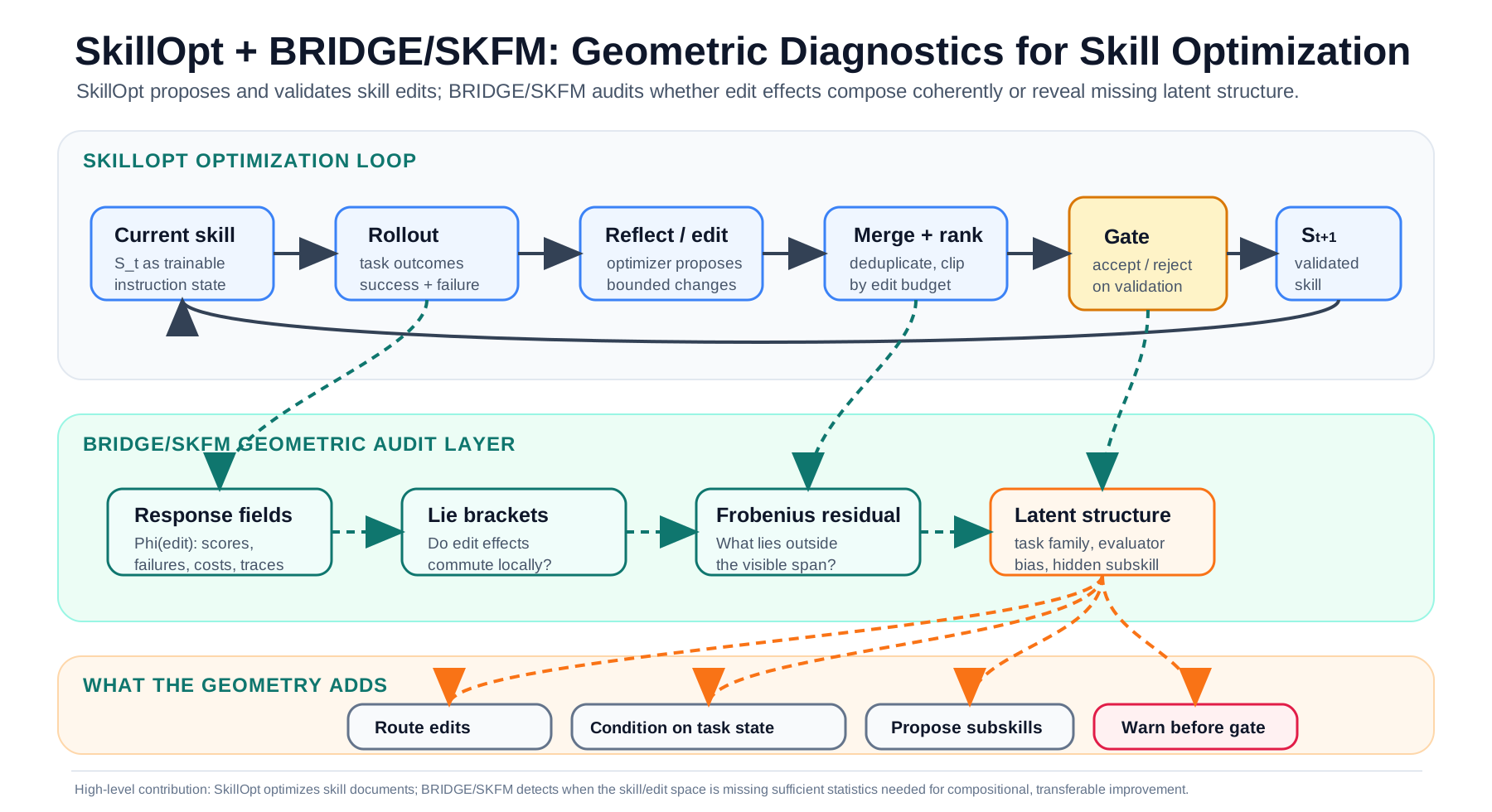
Conditioning pushes a skill forward into candidate behavior. Observation pulls the result back through evidence, constraints, and validation surfaces. SkillOpt makes this duality editable: the transported object is a Markdown skill.
UDL story first
This page is the conceptual layer. Universal Decision Learning treats causal-claim admission as a decision problem: propose better behavior, pull it back through validation surfaces, and preserve uncertainty when the evidence is not strong enough for promotion.
Conceptual map
A Markdown skill is a point in a skill space; an edit is a tangent direction. Rollout extends that direction into behavior, while validation pulls the behavior back through observations, rubrics, and gates.
Conditioning pushes a skill forward into candidate behavior. Observation pulls the result back through evidence, constraints, and validation surfaces. SkillOpt makes this duality editable: the transported object is a Markdown skill.
Differentiating the conditioning/observation duality turns edits into local intervention fields. Non-composing edits become tangent obstructions: signs that the skill needs a qualifier, subskill, task state, or guardrail.
Next layer
The next page names the concrete SkillOpt recipe, shows the three seed traces, reports held-out behavior, and links into individual run artifacts.
The overview stays abstract: UDL, tangent skills, rollout, pullback, and admission gates.
Environment IDs, train/test splits, optimizer details, metrics, charts, and concrete field-level fixes.
Open the SkillOpt experimental drilldown, then inspect seed 42, 43, or 44 only when you want the engine-room trace.