KET Language Modeling Details
This detail layer keeps the experiment visible but subordinate to the story: KET is first demonstrated as a sequence-modeling architecture, then reused as the categorical transport principle behind foundry and UDL examples.
Experiment Provenance
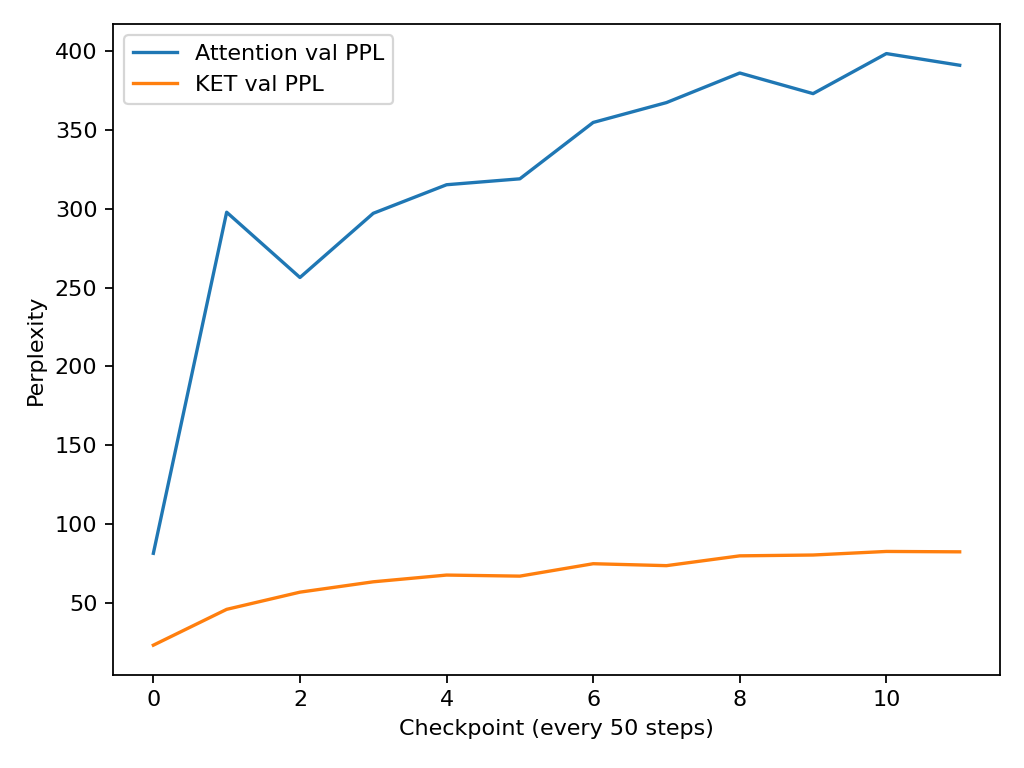
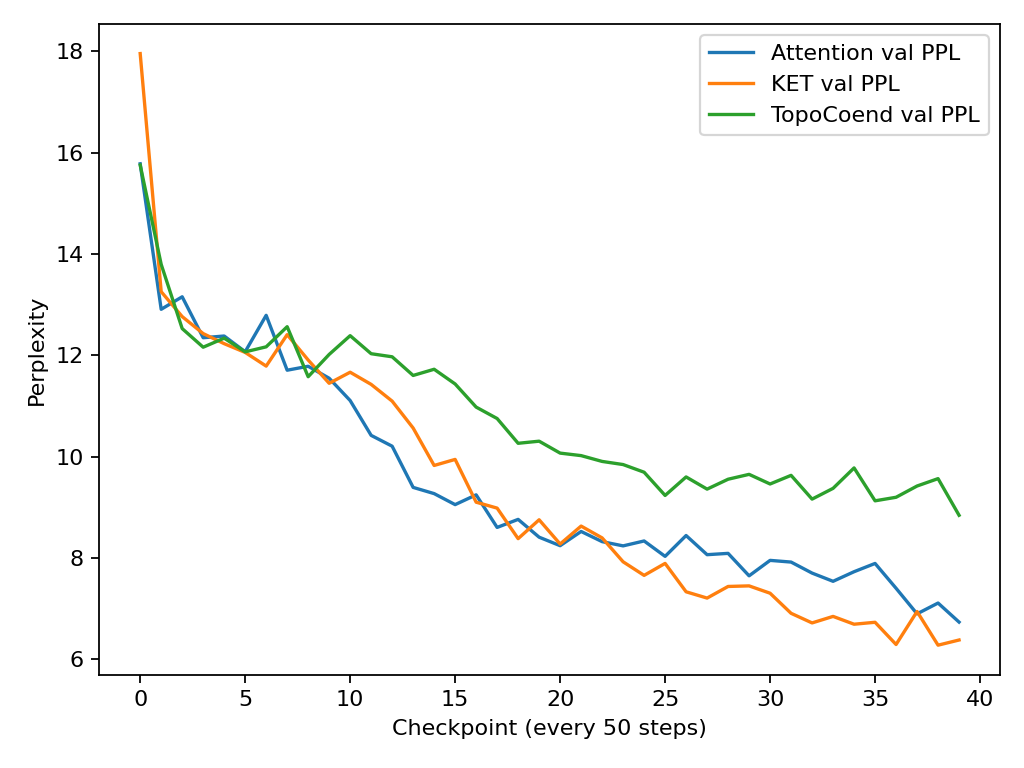
These perplexity curves are experiment artifacts, not schematic drawings. They come from KET language-modeling comparison runs over PTB and WikiText-style benchmarks, with validation perplexity logged by the runner and rendered into the plot files shown below.
Language Modeling Evidence
Why This Matters For The Rest Of The Tutorial
In language modeling, KET transports predictive structure across token contexts. In Odyssey, the transported object becomes a foundry artifact: a claim, skill, dashboard, or causal cell. In UDL, the transported object becomes decision behavior: rollout extends a local policy, while pullback diagnostics check whether the extension remains compatible with gates and evidence.