Sustainable Building
Carbon- and cost-aware scheduling of flexible residential and building loads, from single homes to whole cities
Buildings and homes are among the largest and most flexible electricity loads on the grid. Much of that demand, such as EV charging, heating and cooling, and water heating, can shift in time without affecting the people who use it. My research schedules these flexible loads to cut carbon and cost, and it studies what happens when that flexibility is exercised across a whole city.
Decarbonizing the Home
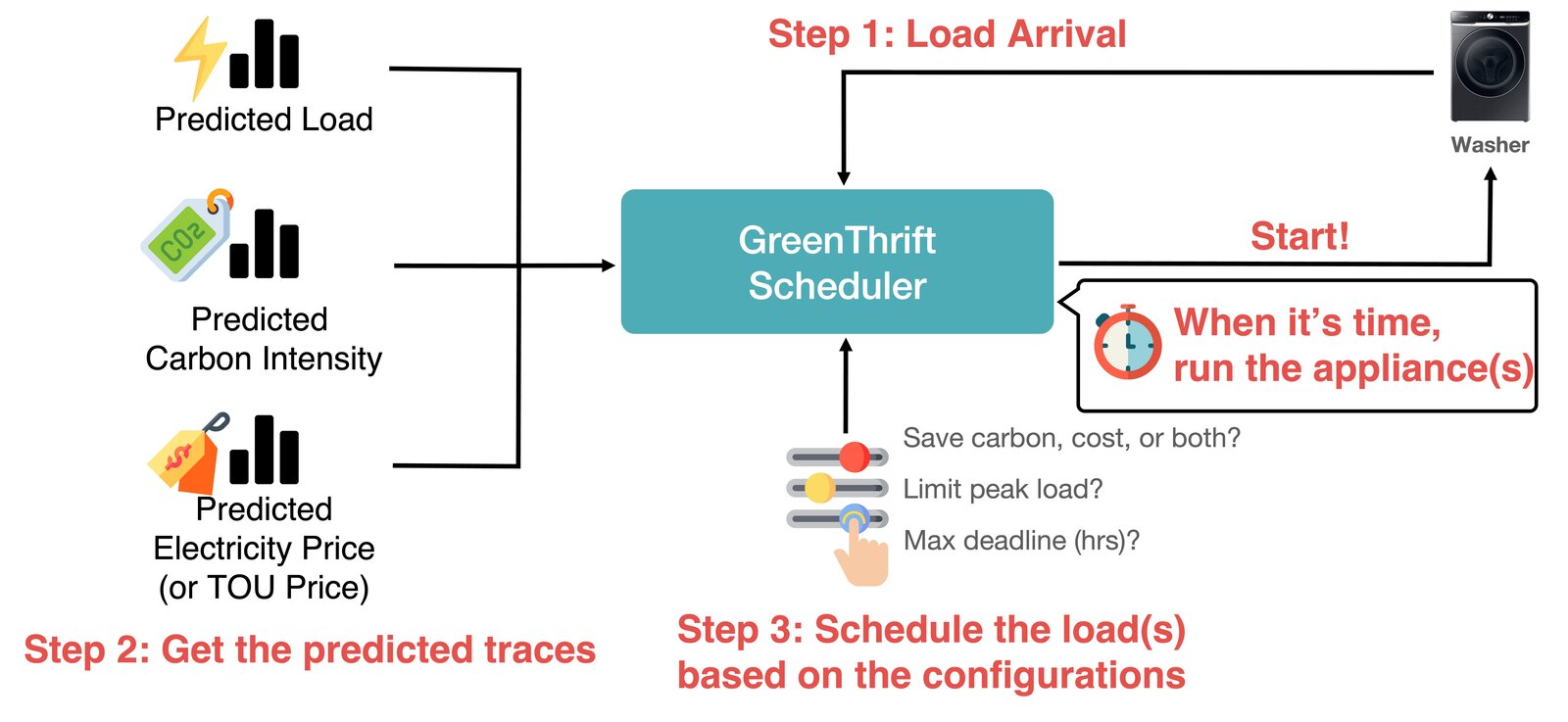
GreenThrift (Bovornkeeratiroj et al., 2025) is a home automation system that schedules flexible residential loads such as EVs, heating and cooling, and appliances. It uses knowledge of future carbon intensity and electricity price to reduce both carbon emissions and cost, and it limits the inconvenience of delaying a load so comfort stays intact.

From Homes to Cities
Household-level strategies do not simply add up across a city. Our study of city-scale decarbonization of residential heating (Mkocheko et al., 2026) shows that when many homes shift heating loads at once, shared distribution infrastructure becomes the binding constraint, especially transformer capacity, so what is optimal for one home can overload the block.

References
2026
- BuildSys ’26
 City-Scale Decarbonization of Residential Heating under Transformer ConstraintsIn Proceedings of the 13th ACM International Conference on Systems for Energy-Efficient Buildings, Cities, and Transportation, Oct 2026