Systems for Foundation Models
Treating foundation models as shared infrastructure to serve, compose, and build systems with
Foundation models (FMs) are heavyweight, general-purpose backbones that many downstream tasks reuse at once. That makes them both a workload to serve efficiently and a tool to build systems with. My research treats FM sharing as a first-class systems problem, and also puts foundation models to work as building blocks inside the systems that manage our infrastructure.
Virtualizing Foundation Models
Deploying a separate copy of a backbone for every task wastes accelerator memory and compute. FMvisor (Shastri et al., 2026) treats the FM backbone as a virtualization substrate, the way a hypervisor virtualizes compute. It gives each task a virtual foundation model (vFM), a logically private model that each task can customize and fine-tune on its own. FMvisor multiplexes many vFMs over a single shared physical FM, and a novel batch-aware fair-share scheduler keeps co-located tasks isolated without giving up the throughput gains of batching them together on the shared backbone.

Composable Model Pipelines
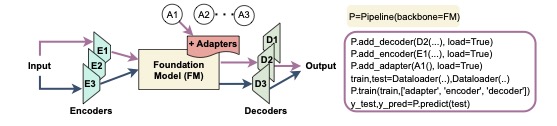
Building a task on top of a foundation model usually means writing an ad-hoc implementation of the encoder, the backbone, an optional fine-tuning adapter, and a decoder head. FMTK (Shastri et al., 2025) is the first toolkit to standardize these components behind common interfaces. A pipeline can then be composed and fine-tuned across different backbones and tasks with minimal code, and the same pipeline can be swapped and benchmarked under consistent settings.

Foundation Models as a Systems Tool
Foundation models can also serve as components inside the systems that manage our infrastructure. FM-CAC (Yang et al., 2026) brings a time-series foundation model into carbon-aware resource and battery management for edge AI. The model forecasts the grid’s carbon intensity, and that forecast decides when a battery-buffered device draws from the grid rather than its battery, along with which software pipeline variant and hardware operating point to run.